The AI Readiness Gap in EHS: From Hype to High-Value Asset
EHS software specifications now include a standard line item: "The system must use AI to provide intelligent suggestions." It is often the most expensive requirement on the tender, and the one the buyer is least prepared to implement.
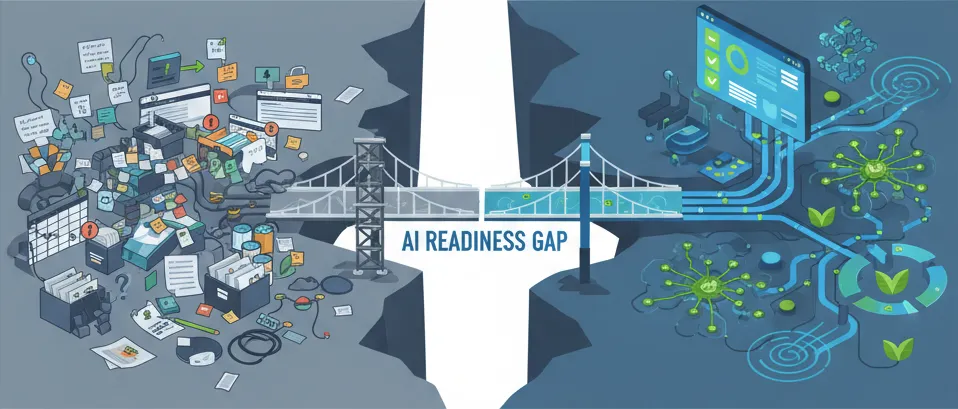
The goal is usually to use AI for predicting incidents. However, most organisations lack clarity on the specific signals they expect AI to deliver. This gap between the high-level vision and operational reality—the AI Readiness Gap—is created by three fundamental misconceptions about how AI is successfully deployed in an enterprise EHS context.
1. AI as a Feature
A client’s specification often includes standard software functions like user authentication and reporting dashboards. Tucked into the same list is a requirement such as developing an AI that identifies hazards on a work site or suggesting root causes after an incident is logged.
The problem is treating AI as just another software feature. In this model, AI is a smart layer you simply activate — a magic wand that instantly makes a system intelligent. Unlike a standard dashboard where a data error is usually obvious, a bad predictive model provides a false sense of certainty. It doesn't just show wrong numbers; it can lead to catastrophic operational decisions based on a signal that isn't there.
Think of it this way: If someone asked you to build a car and then casually added they'd also like it to fly, you wouldn't just add wings. You would explain that a flying car is a fundamentally different machine. What is actually being requested involves complex data pipelines and validated statistical models. It might mean using Natural Language Processing (NLP)—software that reads and "understands" human writing like a high-speed intern—to scan thousands of incident reports. It could involve Computer Vision (CV), a system that "sees" through cameras like a digital safety observer to spot hazards in real-time. These are full-scale R&D initiatives, not simple features on a checklist.
2. Collection Is Not Preparation
Most organizations understand that AI requires data. They proudly state that their new system will build a comprehensive library of incidents that will "feed" their AI. This instinct is correct, but it overlooks a critical truth: raw, unstructured EHS data is like crude oil. It holds immense potential, but it is unusable without extensive refinement.
Consider the reality of typical EHS data:
- In Istanbul, a safety officer writes "slip on wet floor," while a colleague in São Paulo enters "employee fell due to water hazard" for the exact same event.
- The definition of a "Lost Time Incident" varies across business units.
- Severity scores in a risk matrix are subjective and inconsistent from one manager to the next.
For an AI to generate reliable insights from this, a "data refinery" is non-negotiable. This foundational work includes:
- Data Governance: The rules for how you name and enter data so it remains consistent across different sites (e.g., ensuring every site uses the same definition of a "near miss").
- Data Cleansing: Standardizing and correcting historical records.
- Data Labeling: Having EHS experts classify examples (e.g., this incident was due to 'procedural failure') to give the AI verified outcomes to learn from.
Modern Large Language Models (LLMs) are becoming better at parsing messy, unstructured text. However, even the most sophisticated model will "hallucinate" risk if it lacks the cross-system bridges to operational reality. An AI might recognize a "ladder hazard" in a report, but it cannot weigh that risk without knowing the worker's training status or the shift duration.
Furthermore, this "crude oil" is often isolated. True insight requires interoperability. An AI trying to predict risk using only EHS data is working blind. It needs context from HR systems (training records, shift patterns, employee tenure), Maintenance logs (equipment failure rates), and Operations data (production speeds). For example, an AI cannot predict a fatigue-related incident using EHS reports alone. It needs the worker's shift history — living in the HR system — to know they are on their 12th consecutive hour of a night shift. Without that integrated landscape, an AI will either fail completely or, worse, identify spurious patterns and provide dangerously misleading guidance.
3. Building vs. Growing
The most fundamental misconception often lies in the procurement process itself. Organizations issue a specification document, the standard for acquiring software with a fixed scope and delivery date. This model works for conventional software, but AI systems are different by nature.
A machine learning model is never truly "finished." It is not a product you build once; it is a capability that must grow and evolve. An AI risk model requires retraining as new regulations emerge or as operational processes alter the risk landscape. It needs continuous monitoring to detect performance degradation and feedback loops where EHS professionals validate or correct its outputs.
This "Human-in-the-Loop" (HITL) approach is fundamental. It is a process where an expert checks and corrects the AI’s suggestions to ensure they remain accurate and safe. Crucially, this validation work does not add to the safety officer's load. It replaces the hours currently wasted on manual data entry and report cleaning with high-value verification of the system's logic. The AI is not a final "decision-maker"; it is a "decision-support" tool for a competent expert whose real-world judgment is irreplaceable. This iterative, collaborative process is incompatible with a fixed-project mindset. The goal should be a long-term partnership focused on collaboratively improving the system's intelligence.
The Path Forward: A Phased Blueprint for Success
The conversation must shift from "buying an AI" to "building an AI-ready foundation." This is achieved through a practical, phased implementation that manages expectations and de-risks the investment.
Phase 1: Build the Foundation.
The primary focus is implementing a robust management system. This system delivers immediate value by standardizing workflows, but its deeper purpose is to establish the infrastructure and discipline required to capture high-quality, structured data from day one. Critically, this foundation includes a strategy for interoperability, building the data bridges to connect EHS data with other critical systems like HR, Operations, and Maintenance. This foundation immediately reduces administrative burden by automating manual workflows, effectively funding the readiness work for the next phase.
Phase 2: Achieve AI Readiness.
Here, we establish the "data refinery." We implement data governance protocols, cleanse critical historical data, and run a small-scale Proof of Concept (PoC) on a limited, clean dataset. For example, testing a Natural Language Processing (NLP) model to automatically classify unstructured near-miss reports. Automating the classification of thousands of near-miss reports via NLP saves hundreds of expert hours, providing an immediate return on the "data refinery" investment. This not only delivers immediate value by saving expert time but also builds the labeled dataset required for future models. It validates that the data contains valuable patterns and proves the business case for a larger investment.
Phase 3: Introduce Intelligence Incrementally.
Only after the foundation is set do we begin deploying AI features. We start small with a single, high-impact use case. This could be a predictive model for ergonomic risks, or a Computer Vision (CV) model to monitor PPE compliance in a specific area. This feature is not a final deliverable but the start of an evolutionary process where we monitor, gather feedback, and iterate. This Human-in-the-Loop process, where EHS experts actively train and refine the system, is what "grows" the AI from a simple tool into a genuine strategic asset.
The Strategic Value of Honesty
The AI Readiness Gap is not just a technical problem; it is a strategic challenge that, if ignored, leads to failed projects and wasted resources. By building the foundation first, we create the necessary conditions for genuine, long-term success.
For technology providers, this requires shifting the relationship from that of a vendor to a strategic partner. When we help organizations understand not just what they want but what they actually need, we become partners in their success. This demands the courage to tell a client they are not yet ready for what they think they want and the expertise to show them the correct path to get there.
The clients who embrace this disciplined, phased approach are the ones who will ultimately realize the transformative potential of AI, building systems that become true strategic assets.
Ready to Bridge Your AI Readiness Gap?
This checklist provides a step-by-step guide to assess your organization's EHS AI readiness. Identify your strengths, uncover areas for improvement, and build a clear roadmap for success.
Take the Readiness Assessment