Strategic Implementation: A Phased Approach to EHS Software Deployment
Jun 6, 2025
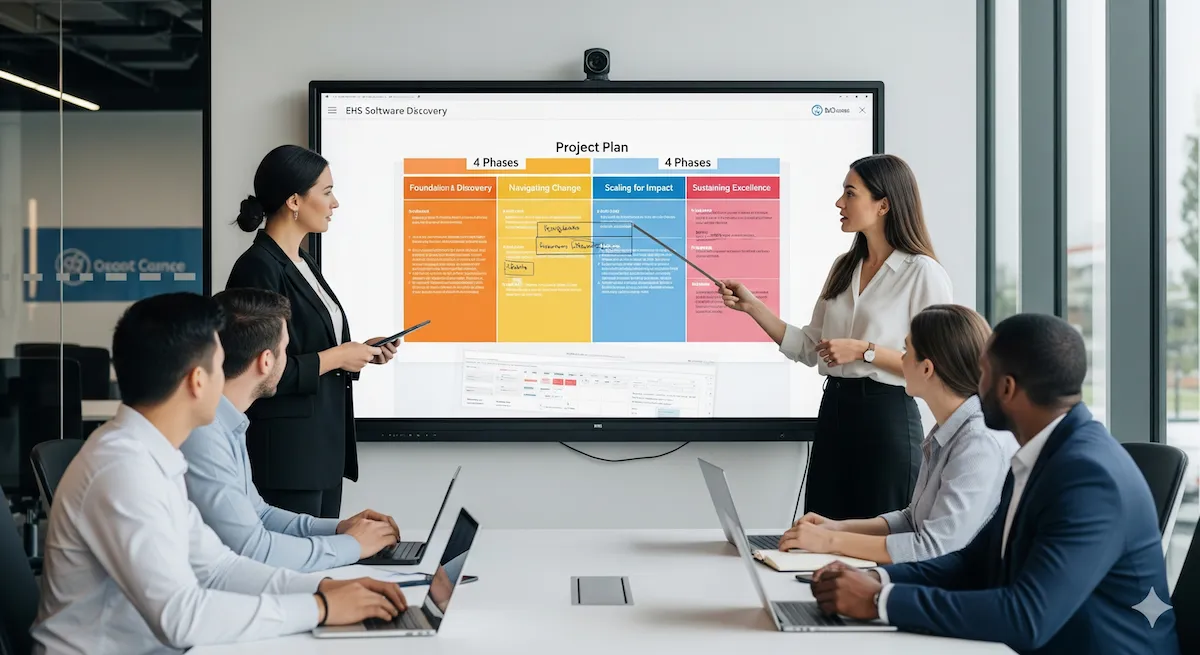
In Part 1: EHS Software: More Than a Technological Fix, we addressed the "plug and play" illusion. Then, in Part 2: The Human Element: Element: Culture & Leadership in EHS Software Success, we explored the vital roles of organizational culture, leadership, and user engagement. Now, in Part 3, we get into the "how-to" of bringing EHS software into your organization effectively. This post focuses on strategic implementation through a carefully planned, phased approach.
The idea that EHS software is a "plug and play" solution is best debunked by outlining the multi-step process needed for successful implementation. A structured, phased approach is essential for managing complexity and ensuring the tool actually aligns with operational reality.1 This is very different from a "big bang" approach. Rapid deployment that ignores workflow alignment simply locks in "UX debt"—digital friction that eventually becomes a permanent safety hazard. A phased approach does not mean a slow approach; it is a method of front-loading the effort to avoid the years of corrective work that follow a failed launch.
Phase 1: Foundation & Discovery – The Critical Needs Analysis
This initial phase sets the stage for the entire project. It is not just about listing software features; it is a strategic effort to define how safety will be managed and to identify the workflow changes needed to reach that vision.
Defining Clear Objectives & Scope
The process begins with a thorough understanding of the organization's specific EHS needs and a clear statement of the problems the software is intended to solve.3 You must identify the EHS processes to be automated or improved.3 A common mistake is to create a 'wish list' of features, which focuses on the tool rather than the outcome.3 Instead, objectives should be strategically aligned with broader business goals. For example, if the goal is to move beyond basic compliance toward a proactive safety culture, the objectives must reflect this.4 A lack of alignment on objectives can derail projects.4 To maintain focus, requirements should be categorized into 'must-haves', 'should-haves', and 'nice-to-haves'.3
Comprehensive Requirements Gathering
This process must include all relevant people: EHS leaders, IT personnel, operations managers, executive sponsors, and, critically, the workers who will interact with the system daily.3 Involving those who will regularly use the EHS software in the selection process is essential.3 This collaborative approach not only ensures that the software will meet various operational needs but also builds early buy-in and a sense of ownership among users, which is crucial for later adoption.5 This phase should involve mapping business processes and considering re-engineering from the start, ensuring that the organization doesn't just automate existing inefficient processes.6
Vendor Evaluation & Selection
Choosing the right EHS software vendor is a strategic decision that extends far beyond comparing features. Organizations should evaluate potential vendors on their industry experience, data security, and system scalability.3 However, the most critical factor is their proven understanding of your unique business needs. While vendors offer "industry standard" workflows, these defaults often reflect what is easiest to code rather than what your specific field reality requires. Blindly adopting a vendor's default process is often just a faster way to automate an existing inefficiency.7, 8
Phase 2: The Pilot – Testing the Workflow
With a clear understanding of needs and a selected vendor, the next phase focuses on introducing the software in a controlled environment to stress-test the new workflows.
The Value of a Pilot Program
Instead of a full-scale, simultaneous rollout, a gradual approach is highly recommended. This involves starting with one or two core modules or deploying the software in a specific site.9 A pilot program allows you to stress-test the software in a real-world setting, gather user feedback, and resolve unforeseen issues on a manageable scale before the enterprise-wide launch. To prevent project fatigue, the gap between the pilot and the full rollout must be bridged by a high-velocity roadmap that turns feedback into visible system improvements in weeks, not quarters.9
Effective Change Management Strategies
Change management is not a side activity but an essential part of every phase of EHS software implementation, from initial communications during the needs analysis to reinforcement activities after going live. Organizational resistance to change is a common and significant challenge. Established change management frameworks like Kotter's 8-Step Model 10 or Prosci's ADKAR Model 11 provide structured methods to systematically manage the human side of the technological transition.
Theoretical models like Kotter’s 8-Step or ADKAR provide the framework, but the field application is what matters. Change management is not a workshop; it is the process of removing the barriers that prevent a worker from using the system. For example, if a supervisor refuses to log inspections because the app takes longer than their notebook, you have a design barrier, not a "willpower" problem. Addressing these friction points—and communicating the fixes—is the only way to build trust.10, 11
Key activities include clear, multi-channel communication and active engagement at all levels. You must transparently address fears—such as the fear that digital records will be used for discipline—and demonstrate how the system makes the worker’s daily life easier. Low user adoption is usually a sign that the system is adding to the workload without solving a single frontline problem.9
Training and Empowering Users
Comprehensive, tailored, and ongoing training is absolutely essential for user proficiency, confidence, and ultimately, software adoption.9 Simply providing one or two days of general training is often insufficient for users to gain true proficiency.9 Training programs should be customized to the specific needs of different user types (e.g., administrators, power users, frontline workers) and their respective tasks within the system.9 A variety of training formats should be employed, including hands-on instruction, interactive web-based sessions, quick reference guides, and opportunities for continued learning and skill refreshment.9 Implementation partners should build training into the project plan from the outset, not treat it as an afterthought.8
Phase 3: Scaling for Impact – Full Deployment and System Integration
Lessons learned from the pilot program inform the strategy for enterprise-wide rollout and deeper integration of the EHS software.
Strategies for Enterprise-Wide Rollout
Full deployment requires a roadmap and a plan for data migration. Data migration is the process of moving your old records—often buried in spreadsheets or old databases—into the new system.6 Even as AI-driven tools begin to automate the technical mapping of old records, the human audit of that data remains the final guardrail. A single error—like a duplicate training record that clears an unqualified worker for a high-risk task—is a systemic failure that software alone cannot catch. Transitioning also requires a review of existing safety processes. You must adapt your workflows to use the new software's strengths, rather than forcing the software to replicate an inefficient manual process.6, 12
Integration with Other Enterprise Systems (especially for Medium/Large Enterprises)
For medium and large enterprises, the value of EHS software increases when it is integrated with other core business systems, such as Enterprise Resource Planning (ERP) or Human Resources Information Systems (HRIS).7 These integrations break down "data silos"—where information is locked in one department—and ensure that records like employee training or equipment maintenance are shared automatically. A significant percentage of organizations recognize the need for this connectivity.13
Seamless integration allows for automated data exchange. For example, pulling employee records from the HR system ensures that safety training profiles are always current without manual entry.14 A complete EHS solution should offer strong integration capabilities, ideally through well-documented APIs. An API is the "digital handshake" that allows two different pieces of software to talk to each other and share information without human intervention.7
Phase 4: Sustaining Excellence – Monitoring, Continuous Improvement, and Evolving with Needs
The "go-live" of the EHS software is the start of a process focused on realizing value and making continuous improvements.
Establishing KPIs and Measuring Performance
To assess the impact of the EHS software and drive ongoing improvements, organizations must define Key Performance Indicators (KPIs) aligned with their EHS objectives.15 These KPIs might include lagging indicators such as incident rates (TRIR, LTIR), and leading indicators such as safety observations or corrective action closure rates. The goal of this phased alignment is not just user satisfaction; it is the creation of a data model clean enough to identify the precursor signals—the "small" deviations that occur before a major incident—that actually prevent fatalities.1
Post-Implementation Review & Continuous Improvement
After the system has been operational for a period, conduct formal post-implementation reviews. These reviews are a chance to gather feedback from users, identify what worked during the rollout, and document lessons learned for future system enhancements.2 This feedback loop is essential for a culture of continuous improvement. The EHS system must be adaptable, capable of evolving to meet new regulatory requirements and emerging risks as the organization grows.1
The selection of an implementation partner is as critical as the choice of the software itself, particularly for complex deployments that require significant configuration, data migration, system integration, and strong change management support. Vendors often provide implementation services, and some projects may involve third-party consultants.7 However, an inexperienced or misaligned implementation partner can lead to incorrect system setup, poor user adoption, excessive and problematic customizations, and ultimately, system failure, even if the underlying software is sound.6 The case of a WSP client using Enablon illustrates how an uncertified implementation partner contributed to significant issues, requiring a major remediation effort.17 Therefore, thorough due diligence on the implementation partner's expertise, their proposed methodology (e.g., adherence to PMI standards 2), relevant industry experience, and their approach to training and change management is vital. This due diligence should extend beyond just the software vendor's general reputation to the specific team and processes that will be involved in the implementation.
A successful EHS software deployment is a carefully orchestrated process involving clear objectives, user buy-in, and careful planning through distinct phases.
Coming up in Part 4: We’ll look at "Measuring Success: Real-World ROI of EHS Software," demonstrating how to quantify the value your EHS software brings.
References
- Building a Strong EHS Program: A Guide for Every Organization, https://www.ehsschool.com/blog/build-strong-ehs-program/
- A PMI-Tested Approach: Implementation Phases | SafetyStratus, https://www.safetystratus.com/blog/pmi-tested-ehs-software-implementation-phases/
- 5 Mistakes that make your EHS software selection a failure - 2025, https://ehscongress.com/5-mistakes-that-make-your-ehs-software-selection-a-failure/
- 5 Pitfalls of EHS Software Implementation - ecoPortal, https://www.ecoportal.com/blog2/5-pitfalls-of-ehs-software-implementation
- Essential Steps for Selecting the Right EHS Software | 10xDS, https://10xds.com/blog/essential-steps-for-selecting-the-right-ehs-software/
- Why EHS Software Implementations Fail - How to Avoid It - SciShield, https://www.scishield.com/community-hub/why-ehs-software-implementations-fail-and-how-to-avoid-it
- The complete guide to evaluating EHS software - Locus Environmental, https://www.locusenvironmental.com/wp-content/uploads/2017/08/Evaluating-EHS-Software.pdf
- How to Choose the Right Chemical ERP Implementation Partner, https://alchemy-365.com/blog/how-to-choose-the-right-chemical-erp-implementation-partner/
- Why Isn't Your Team Using EHS Software? (And What to Do About It), https://www.cloudapper.ai/workplace-safety/why-isnt-your-team-using-ehs-software-and-what-to-do-about-it/
- Kotter's Change Management Theory Explanation and Applications, https://www.prosci.com/blog/kotters-change-management-theory
- Change Management Models: 5 Proven Frameworks with Examples, https://www.heflo.com/blog/change-management-models
- Unlocking the Full Potential of EHS Technology: Insights from Industry Leaders - Cority, https://www.cority.com/blog/full-potential-of-ehs-technology-expert-insight-from-industry-leaders/
- Predictions for EHS Technology in 2025 and Beyond - Pro-Sapien, https://www.pro-sapien.com/blog/ehs-predictions-for-2025/
- HRIS Integration: The Complete Guide for HR Leaders - Paycor, https://www.paycor.com/resource-center/articles/hris-integration/
- What are the best practices for defining EHS performance indicators? | Simple But Needed, https://sbnsoftware.com/blog/what-are-the-best-practices-for-defining-ehs-performance-indicators/
- Employee engagement - Safety+Health magazine, https://www.safetyandhealthmagazine.com/articles/26756-employee-engagement
- How WSP's EHS Management System Experience Helped a Client Get Back on Track, https://www.wsp.com/en-us/projects/how-wsp-ehs-management-system-experience-helped-a-client-get-back-on-track